
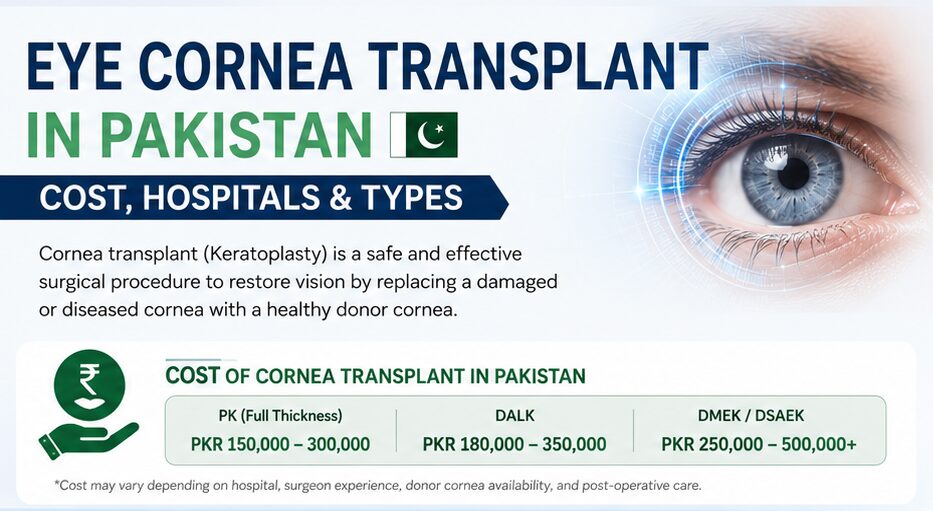
This guide covers eye corneal transplants in Pakistan, including cost ranges, hospital comparisons, transplant types, and the donor shortage crisis. It does NOT address post-surgical complications requiring specialist management or transplants for children under 10, as those require separate clinical guidance.
What Is a Corneal Transplant? (And Who Actually Needs One)
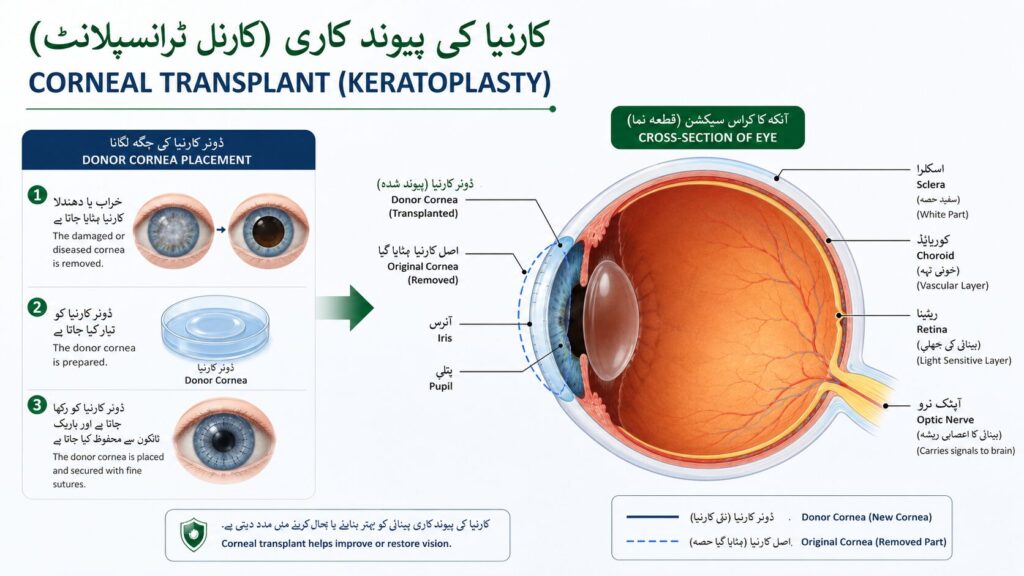
Eye cornea transplant in Pakistan, also called keratoplasty or corneal grafting, is a surgical procedure in which a damaged or diseased cornea is removed and replaced with healthy donor tissue. The cornea is the clear, dome-shaped front surface of the eye that focuses incoming light. When it becomes scarred, thinned, or clouded, no glasses or contact lenses can fully correct the vision loss.
The most common reason Pakistanis need this surgery is keratoconus a condition where the cornea gradually thins and bulges into a cone shape, distorting vision progressively from the teenage years onward. Other causes include corneal infections (fungal or bacterial), chemical injuries, and failure of a previous eye operation.
According to Al-Shifa Trust Eye Hospital and the LRBT Vision Report (2023), an estimated 200,000 Pakistanis suffer from corneal disease causing significant vision impairment yet Pakistan’s largest corneal transplant centre performs only around 800 transplants per year. That gap is the core problem every patient faces when they first search for help.
The Donor Shortage Crisis — Why Getting a Cornea in Pakistan Is Hard
This is the one thing most hospital websites won’t say directly.
Pakistan does not have a functioning national eye bank. Almost every cornea used in transplant surgery here is imported primarily from eye banks in the United States and Sri Lanka. That import process adds cost, adds waiting time, and makes the entire system fragile. A single logistics delay can push a scheduled surgery back by weeks.
Or maybe I should say it this way: the shortage isn’t just a supply chain issue. It’s a cultural and awareness issue too.
Many families in Pakistan hesitate to consent to cornea donation after a loved one’s death because of genuine uncertainty about whether Islam permits it. This hesitation has real consequences for the 200,000 people waiting.
Here’s the actual religious ruling, because no competitor site covers it clearly: The Council of Senior Islamic Scholars has declared cornea donation after confirmed death to be permissible (halal) under Shariah, based on the principle of darurah (necessity) giving precedence to the interests of the living. The Islamic Fiqh Council issued a formal ruling to this effect as far back as 1988 in Jeddah. The deceased person loses nothing, as the LRBT’s own fatwa references state, because the eyes will turn to dust regardless. LRBT’s cornea donation page documents multiple fatwas from both national and international scholars confirming this position.
Al-Shifa Trust Eye Hospital has established Pakistan’s only in-country eye bank in Rawalpindi specifically to address the shortage and they allow anyone to register a cornea donation pledge online. If even a fraction of Pakistan’s 230 million people registered, the waiting list would disappear within years.
What most guides skip is the practical step: registering as a donor costs nothing and takes five minutes at alshifaeye.org. That one act is arguably more impactful than any donation of money.
Types of Corneal Transplant Available in Pakistan
Not every hospital offers every type. Knowing the difference helps you ask the right questions.
Quick Comparison
| Transplant Type | Best For | Key Benefit | Limitation |
|---|---|---|---|
| Penetrating Keratoplasty (PK) | Full corneal damage, severe scarring | Replaces entire cornea; widely available | Longest recovery (12–18 months); higher rejection risk |
| DALK (Deep Anterior Lamellar Keratoplasty) | Keratoconus, stromal scarring (inner layer intact) | Lower rejection risk; inner layer preserved | Technically demanding; fewer surgeons trained in PK |
| DSAEK (Descemet Stripping Automated Endothelial Keratoplasty) | Fuchs’ dystrophy, endothelial failure | Sutureless; faster recovery (~8 weeks) | Vision ceiling around 20/30 |
| DMEK (Descemet Membrane Endothelial Keratoplasty) | Fuchs’ dystrophy; endothelial disease | Fastest recovery (~2 weeks); best vision outcomes (20/25 or better) | Most technically demanding; very few centres in Pakistan offer it |
Liaquat National Hospital (LNH) in Karachi is currently one of the few centres in Pakistan performing both DMEK and DSAEK both registered with HOTA (Human Organ Transplant Authority) and sourcing tissue from US and Sri Lankan eye banks. Bahria International Hospital in Lahore holds approval from PHOTA (Punjab Human Organ Transplant Authority) and is one of the province’s approved transplant centres for private patients.
To determine which procedure you need, follow these steps:
- Get a corneal topography scan (available at most specialist eye hospitals costs roughly Rs. 1,500–3,000)
- Confirm with your ophthalmologist which corneal layers are affected
- Ask specifically whether DALK or PK is recommended for your diagnosis, and why
- Verify that your chosen hospital holds HOTA or PHOTA registration before booking surgery
Which Hospitals Perform Corneal Transplants in Pakistan?
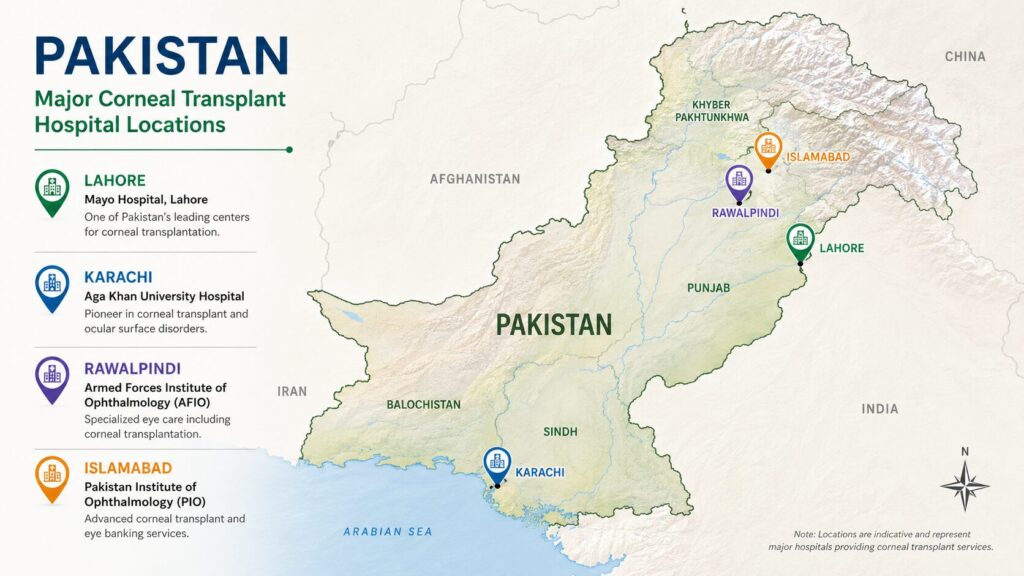
Here are the verified, HOTA/PHOTA-registered options with honest notes on what each does well and where their limitations are.
Public and Charitable Hospitals (Low or No Cost)
Al-Shifa Trust Eye Hospital Rawalpindi Pakistan’s largest corneal transplant centre. Approximately 800 transplants per year. Houses the country’s only established eye bank, which accepts donor registrations. Subsidised pricing for low-income patients.
LRBT Hospital Karachi and Lahore Completely free for qualifying patients. Has performed over 1,077 corneal transplants at zero cost to recipients. Sourced corneas through Lions Club International Canada, among others.
Guide to free eye surgery Pakistan → “how to qualify for free cornea surgery in Pakistan”
APPNA Corneal Transplant Project Multiple Cities A US-based Pakistani physician group that has sent over 5,600 corneas to Pakistan since 2017, distributed across hospitals in Karachi, Lahore, Faisalabad, Rawalpindi, Quetta, and more. Completely free for recipients. Worth checking if you’re in a smaller city APPNA partners with DHQ hospitals in Sargodha, Sialkot, Gujranwala, and others.
Mayo Hospital Lahore Government teaching hospital with active ophthalmology unit. Part of the APPNA distribution network.
Private Hospitals
Liaquat National Hospital (LNH) Karachi One of Pakistan’s few centres offering DMEK and DSAEK. HOTA-registered. Internationally trained surgeons. Day-care procedure under general anaesthesia in most cases. Expect 3–4 weeks off work minimum post-surgery.
Bahria International Hospital Lahore PHOTA-approved. Internationally trained cornea surgeons. Claims 100% success rate across 500+ eye surgeries since 2017. 24-hour emergency eye cover available.
Shifa International Hospital Islamabad Private facility with dedicated corneal transplant unit and modern surgical suites.
Aga Khan University Hospital (AKUH) Karachi Premium private care with internationally credentialed surgeons. Highest cost tier but comprehensive pre- and post-operative management.
What Does a Corneal Transplant Cost in Pakistan?
I’ve seen conflicting data on this some sources list consultation fees only (Rs. 500–4,000), which is just the doctor’s visit, not the surgery. Others quote surgery figures without breaking down what’s included. My read, based on aggregating hospital data and HOTA-registered centre information, is this:
The real cost breakdown for a private patient:
| Cost Component | Estimated Range (PKR) |
|---|---|
| Corneal tissue (imported from US/Sri Lanka eye bank) | Rs. 150,000 – 300,000 |
| Surgeon’s fee | Rs. 50,000 – 150,000 |
| Hospital/OT charges | Rs. 30,000 – 80,000 |
| Pre-op investigations (topography, labs) | Rs. 5,000 – 15,000 |
| Post-operative medications (3–6 months) | Rs. 10,000 – 30,000 |
| Total estimated (private, full-cost) | Rs. 245,000 – 575,000 |
No hospital publishes this breakdown publicly. That gap is exactly why this article exists.
For DMEK (the most advanced technique), costs skew toward the higher end because the tissue preparation is more specialized. At public/charitable centres like LRBT or through APPNA, the surgery itself is free though you may still pay for medications and follow-up visits.
Look if you’re a middle-income family in Lahore trying to figure out whether you can afford this without selling assets, the honest answer is: Al-Shifa Trust and APPNA are your first calls, not a private hospital. The surgery quality at these institutions is clinically sound. Private hospitals offer faster scheduling and more premium facilities, but not necessarily better surgical outcomes for standard keratoplasty.
Recovery: What to Expect After Surgery
Recovery timelines vary significantly by procedure type.
For PK (full-thickness), vision improvement is slow. The eye needs 12–18 months to fully stabilise, and sutures may remain in place for over a year. You’ll be off work for at least 4–6 weeks and must avoid any physical activity that risks eye impact.
DSAEK recovery runs about 8 weeks for functional vision. Patients are required to lie flat for 1–2 days post-surgery while an air bubble holds the new tissue in position a detail most Pakistani patients aren’t warned about beforehand.
DMEK is the fastest: many patients see functional improvement within 2 weeks. Vision of 20/25 or better is achievable. At LNH, doctors report patients achieving this level of vision with DMEK.
Quick note: vision is often worse immediately after surgery than it was before. That’s normal. The eye is adjusting to new tissue. Don’t judge the outcome for at least 3 months.
Post-operative care is non-negotiable. You’ll need antibiotic and steroid eye drops for months. Missing doses raises the risk of graft rejection the single most common serious complication of corneal transplant.
The Rejection Risk — And How to Catch It Early
Some experts argue that graft rejection is rare enough that patients don’t need to worry excessively. That’s valid if the patient attends all follow-up appointments and takes medications religiously. But if you’re in a city without a specialist cornea unit Multan, Peshawar, rural Punjab follow-up access is genuinely difficult, and that changes the risk calculus.
Signs of rejection to report immediately:
- Sudden redness in the transplanted eye
- Sensitivity to light that wasn’t present before
- Vision becoming blurry or hazy
- Pain or irritation that worsens over 24–48 hours
Rejection can often be reversed with prompt steroid treatment. The window is short. This is why choosing a hospital with accessible emergency ophthalmology coverage matters not just for the surgery itself, but for the 2 years afterward.
Voice Search Q&A
Q: What’s the best hospital for corneal transplant in Pakistan?
A: Lions Medical Complex in Lahore is Pakistan’s largest centre, performing around 800 transplants annually. For advanced DMEK surgery.
Q: How much does a corneal transplant cost in Pakistan?
A: For a private patient, total costs including imported corneal tissue, surgery, and medications range from roughly Rs. 245,000 to Rs. 575,000. Charitable options through APPNA and LRBT are available at no cost for qualifying patients.
Q: Should I get a corneal transplant at a government or private hospital in Pakistan?
A: For low-income patients, LRBT and APPNA-partner government hospitals offer free surgery with competent surgeons. Private hospitals like LNH or Bahria offer faster scheduling, advanced techniques like DMEK, and more streamlined aftercare.
Q: Why does Pakistan have a corneal donor shortage?
A: Pakistan lacks a national eye bank, so most corneas are imported from the US and Sri Lanka. Low domestic donation rates partly driven by religious misconceptions and the absence of coordinated donor registration systems compound the shortfall.
Q: When should I see a specialist about a corneal transplant?
A: If your ophthalmologist has told you that glasses or rigid contact lenses can no longer correct your vision, or if your keratoconus is progressing, seek a corneal specialist evaluation immediately. Early referral to a HOTA-registered centre improves your surgical outcome.
Disclaimer: This article is for informational purposes only and does not constitute medical advice. Consult a qualified ophthalmologist registered with the Pakistan Medical and Dental Council (PMDC) before making any surgical decision. Costs cited are estimated ranges and may vary by hospital, year, and individual clinical factors.