Cataract Surgery in Pakistan 2025: Real Costs, IOL Types & What Clinics Don’t Tell You Upfront
This guide covers breakdowns of Cataract Surgery Cost in Pakistan, surgery types, and hospital selection for adults in Pakistan’s major cities. It does NOT address congenital cataracts in children or post-surgical complications requiring specialist management.
Medical disclaimer: This article is for informational purposes only and does not constitute medical advice. Always consult a qualified ophthalmologist before making any treatment decision.
You called one clinic. They said Rs. 50,000. You called another. They said Rs. 270,000. Neither explained why.
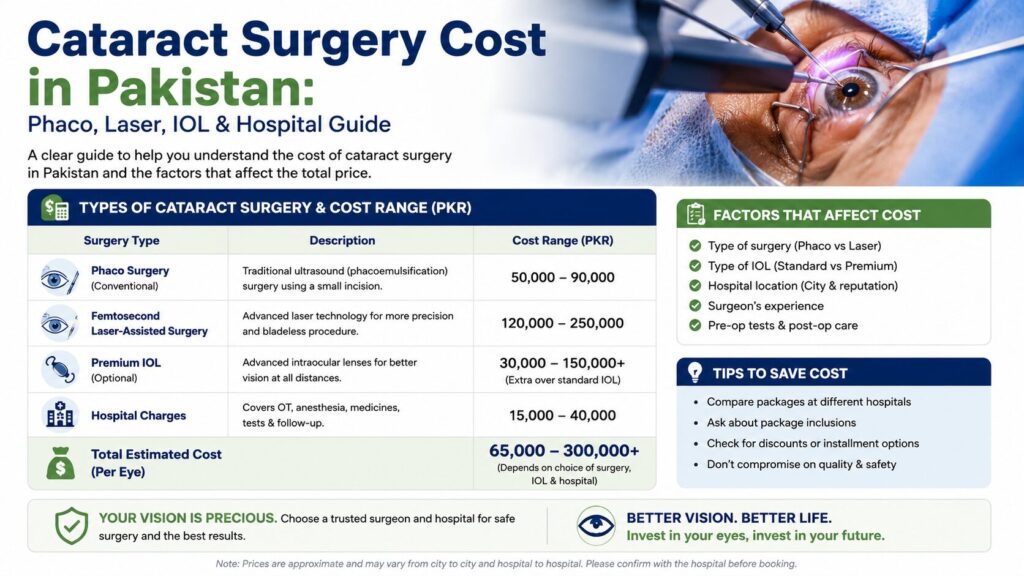
That gap isn’t random and it’s not about one clinic being better than the other. It’s about three variables almost nobody explains upfront: the surgery method, the IOL lens type, and the hospital tier. Once you understand those three, every quote you receive will make complete sense.
Cataract surgery is a procedure to remove the eye’s clouded natural lens and replace it with a clear artificial lens called an intraocular lens (IOL). The surgery itself takes 15–30 minutes per eye. What varies dramatically in Pakistan and globally is which surgical technique is used to remove the lens, and which IOL goes in its place.
According to the Pakistan National Blindness and Visual Impairment Survey (PMC/NCBI, 2007), approximately 570,000 adults in Pakistan are blind due to cataract, and 76.1% cited cost of surgery as their primary barrier to treatment. That stat isn’t just sobering it tells you exactly why price transparency matters here more than almost anywhere else.
Why Cataract Surgery Costs Rs. 40,000 in One Clinic and Rs. 290,000 in Another
The short answer: they’re not quoting the same thing.
Here’s the thing: when a clinic quotes you Rs. 50,000, they’re almost certainly quoting traditional phacoemulsification with a basic monofocal IOL. When another quotes Rs. 270,000, they’re probably quoting femtosecond laser-assisted cataract surgery with a premium trifocal IOL. These are genuinely different procedures with different outcomes not a markup on the same service.
The three cost drivers, in order of impact:
1. IOL lens type this is the single biggest price variable. 2. Surgery method Phaco vs Femto laser. 3. Hospital tier government, mid-tier private, or premium private.
Everything else surgeon fee, anesthesia, post-op kit is relatively stable across facilities.
The IOL Lens Types Available in Pakistan — And What Each Actually Costs
Most guides list lens types. None of them tell you what each costs in a Pakistani hospital in 2025. Here’s the real breakdown.
Monofocal IOL — The Standard Option
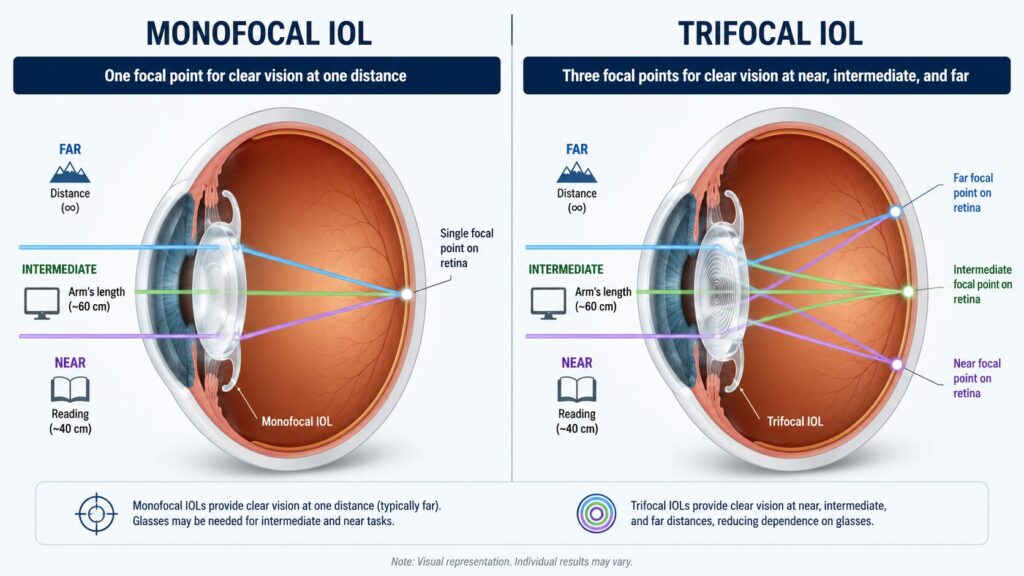
A monofocal lens corrects vision at one distance usually far. You’ll still need reading glasses afterward. This is the lens included in most “starting from Rs. 50,000” quotes.
Cost range: Rs. 40,000 – Rs. 90,000 per eye (surgery + lens + standard follow-up). Best for: Patients on a fixed budget, or those comfortable continuing with reading glasses. Limitation: No correction for near vision or astigmatism.
Toric IOL — For Patients With Astigmatism
A toric lens corrects astigmatism at the same time as the cataract is removed. If your parent’s ophthalmologist has mentioned astigmatism as a secondary concern, this is worth discussing.
Cost range: Rs. 80,000 – Rs. 150,000 per eye. Available at: VisionX Laser and Eye Clinic, Lahore; Amanat Eye Hospital, Lahore; Aga Khan University Hospital, Karachi.
Trifocal IOL — The “Glasses-Free” Option
A trifocal lens corrects near, intermediate, and distance vision simultaneously. The goal is complete independence from glasses after surgery a meaningful quality-of-life upgrade, especially for an active older patient.
Cost range: Rs. 150,000 – Rs. 290,000 per eye. Realistic expectation: Most patients achieve significant spectacle independence, but a small percentage still need glasses for specific tasks. No IOL carries a 100% guarantee.
Quick note: Prices above are per eye. If both eyes need surgery, the total cost doubles and most surgeons recommend waiting 1–3 weeks between procedures.
Phaco vs Laser Cataract Surgery: Which One Does Your Parent Actually Need?
Quick Comparison
| Option | Best For | Key Benefit | Limitation |
|---|---|---|---|
| Phacoemulsification (Phaco) | Standard cataracts, budget-conscious patients | Proven, widely available, lower cost | Relies on surgeon hand skill for incision precision |
| Femtosecond Laser-Assisted | Dense cataracts, patients wanting maximum precision | Computer-guided incisions, more consistent capsulotomy | Significantly higher cost; not all clinics have the equipment |
| Traditional (non-Phaco) | Rural/low-resource settings | Lowest cost | Larger incision, longer recovery |
Phacoemulsification (Phaco) uses ultrasound energy to break up the cloudy lens before removing it through a tiny incision. It’s the global standard. Almost every private clinic in Lahore and Karachi performs it. Recovery is fast most patients see improvement within days, with full healing around 6–8 weeks.
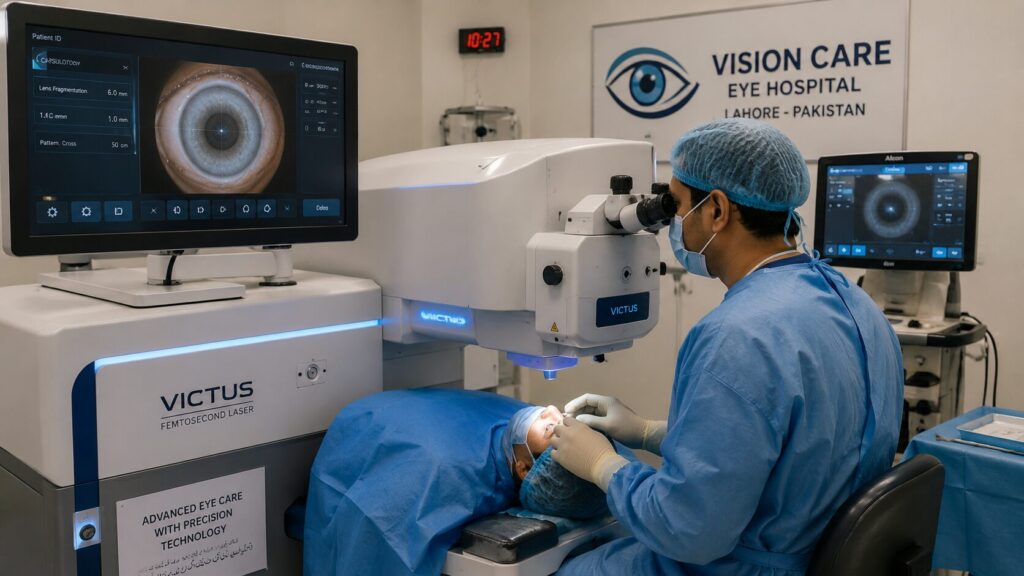
Femtosecond laser-assisted surgery replaces the surgeon’s manual blade with a computer-controlled laser for the initial incisions. The precision is genuinely higher particularly for the capsulotomy (the circular cut in the lens membrane). Amanat Eye Hospital in Lahore was the first clinic in Pakistan to offer the third-generation Femto cataract procedure, which gives them a legitimate edge in this specific area.
Or maybe I should say it this way: Femto isn’t always “better” it’s more precise, which matters most for premium IOL placement. If you’re going with a basic monofocal, the incremental benefit of Femto is smaller. If you’re spending on a trifocal, Femto precision is worth the premium.
Some surgeons argue that an experienced phaco surgeon achieves outcomes comparable to Femto for standard cases. That’s valid for straightforward cataracts with an expert operator. But if the lens density is high or the patient has a small pupil or prior eye surgery, laser-assisted has a documented advantage.
Hospital-by-Hospital Breakdown: Lahore and Karachi
Lahore
Amanat Eye Hospital: Pioneer of Femto cataract in Pakistan. Offers the full range from traditional Phaco to 3rd-generation Femto-assisted surgery. Well-regarded for complex cases. Premium tier.
VisionX Laser and Eye Clinic: Located near Shaukat Khanum Memorial Hospital, Lahore. Offers trifocal and toric IOL options. Strong reputation for refractive and cataract work. Mid-to-premium tier.
Lions Medical Complex: More accessible pricing point. Established institution. Good for standard Phaco with monofocal IOL if budget is the primary constraint.
LRBT (Layton Rahmatulla Benevolent Trust): Free or heavily subsidized cataract surgery for patients who qualify on income grounds. Quality of care is consistently praised. If cost is a genuine barrier, this is a real option not a charity compromise.
Karachi
Aga Khan University Hospital: Published package pricing (a rarity among Pakistani hospitals), institutional oversight, and comprehensive pre/post-op protocols. The most transparent on cost in Karachi. Premium tier.
South City Hospital: Mid-tier private. Phaco + monofocal available at more accessible price points.
The Eye Center, Karachi: Private specialist center. Strong reputation for cataract and refractive work.
The Hidden Costs Nobody Puts in the Quote
Look if you’ve been quoted Rs. 80,000 and feel relieved, here’s what you need to ask before you sign anything.
Pre-operative biometry: Before surgery, your parent needs an A-scan or optical biometry to measure the eye precisely for IOL power calculation. Some clinics include this. Many don’t. Cost if separate: Rs. 3,000–8,000.
Post-operative eye drops: After surgery, patients typically use antibiotic + anti-inflammatory drops for 4–6 weeks. A standard post-op drop kit runs Rs. 2,500–6,000. You’ll purchase these from the clinic pharmacy or independently.
Follow-up consultations: Most clinics include 1–2 follow-ups in the package. Anything beyond that is billed separately. Ask how many follow-ups are covered.
Per eye vs both eyes: This should go without saying, but always confirm: is the quote per eye or for both? Given the volume of confusion on this point, just ask directly.
The “package” question: When Aga Khan University Hospital publishes cataract packages, those typically include pre-op work-up, surgery, IOL, and follow-ups in a bundled price. When a smaller clinic quotes you, they’re often quoting surgery + IOL only. The bundled vs unbundled difference can easily explain a Rs. 30,000–50,000 discrepancy between clinics that are actually very similar in quality.
I’ve seen conflicting data on whether private clinic pricing in Pakistan has stabilized post-2022 inflation. Some sources cite price increases of 30–40% in medical services since 2022; others suggest eye surgery specifically has remained more stable due to equipment cost parity. My read: always get a written breakdown before booking, not just a verbal quote.
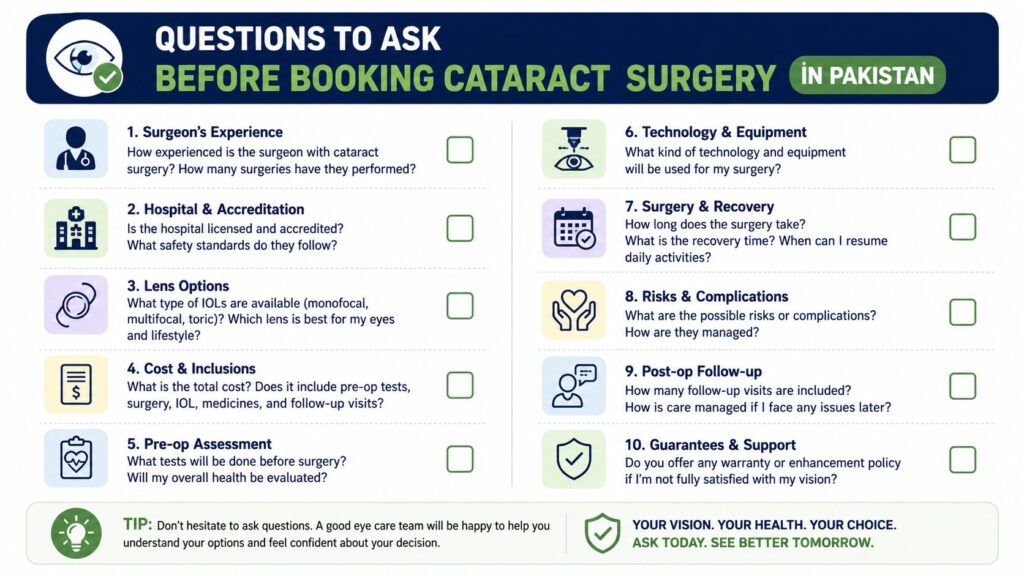
How to Choose the Right Option for Your Parent — A Practical Framework
To choose the right cataract surgery package, follow these steps:
- Get the ophthalmologist’s diagnosis report in writing confirm lens density and whether astigmatism is present.
- Decide on IOL goal: glasses-free ambition (trifocal) vs budget-first (monofocal).
- Request itemized written quotes from at least two clinics pre-op, surgery, IOL, drops, follow-ups listed separately.
- Confirm surgery method: Phaco or Femto and ask which the surgeon recommends for this specific case.
- Ask about the surgeon’s caseload: how many cataract procedures do they perform per month.
A surgeon doing 50+ cases per month has a meaningfully different skill level than one doing 5. That matters more than clinic branding.
What Most People Get Wrong About “Cheaper” Cataract Surgery
The counter-intuitive truth: cheaper surgery isn’t inherently riskier. The surgery method and surgeon skill matter far more than the price tag.
A Rs. 50,000 phaco with a high-volume experienced surgeon at a reputable mid-tier clinic is, by most clinical measures, a lower-risk procedure than a Rs. 150,000 surgery at a premium-branded clinic where the operating surgeon has limited cataract volume. Pakistan has excellent ophthalmologists at every price tier. What you’re paying more for at premium hospitals is mostly the IOL upgrade, the facility experience, and the administrative reliability of bundled packages.
What most guides skip is this: the IOL brand and origin also varies by price. Premium IOLs from Alcon (AcrySof), Johnson & Johnson (Tecnis), or Carl Zeiss (AT LISA) cost significantly more than generic equivalents and the difference in optical quality is real for active patients. Ask your clinic which IOL brand is included in their quote.
Voice Search Q&A
Q: What’s the average cost of cataract surgery in Pakistan in 2025?
A: Cataract surgery in Pakistan costs roughly Rs. 40,000–Rs. 100,000 for standard phaco with a monofocal IOL. Premium laser surgery with a trifocal lens can reach Rs. 270,000–Rs. 290,000 per eye.
Q: How do I know which IOL lens is right for my parent?
A: Ask the surgeon whether astigmatism is present (toric IOL needed) and whether the patient wants to avoid glasses entirely (trifocal). For most budget-conscious patients, a monofocal IOL works well with reading glasses afterward.
Q: Should I choose laser or traditional cataract surgery in Pakistan?
A: Standard phacoemulsification is safe and widely available. Femtosecond laser is worth considering for premium IOL placement or complex cases but for straightforward cataracts, an experienced phaco surgeon delivers comparable outcomes.
Q: Why does cataract surgery cost so much more at Aga Khan than other hospitals?
A: AKUH prices include bundled pre-op, surgery, IOL, and follow-up in one package. Smaller clinics often quote surgery + IOL only, making the AKUH price look higher even when the actual difference is smaller once all costs are added.
Q: When should I book cataract surgery how urgent is it?
A: Cataracts are rarely a surgical emergency, but vision typically worsens gradually without treatment. Most ophthalmologists recommend surgery when the cataract meaningfully impairs daily activities driving, reading, or recognizing faces.